Bengaluru, October 29, 2026: The National Testing Agency (NTA) has issued a fresh registration advisory for candidates applying for the Joint Entrance Examination (JEE) Main 2027 Session 1. The advisory highlights important instructions regarding DigiLocker, digital identity verification and the accuracy of personal details in the online application form.
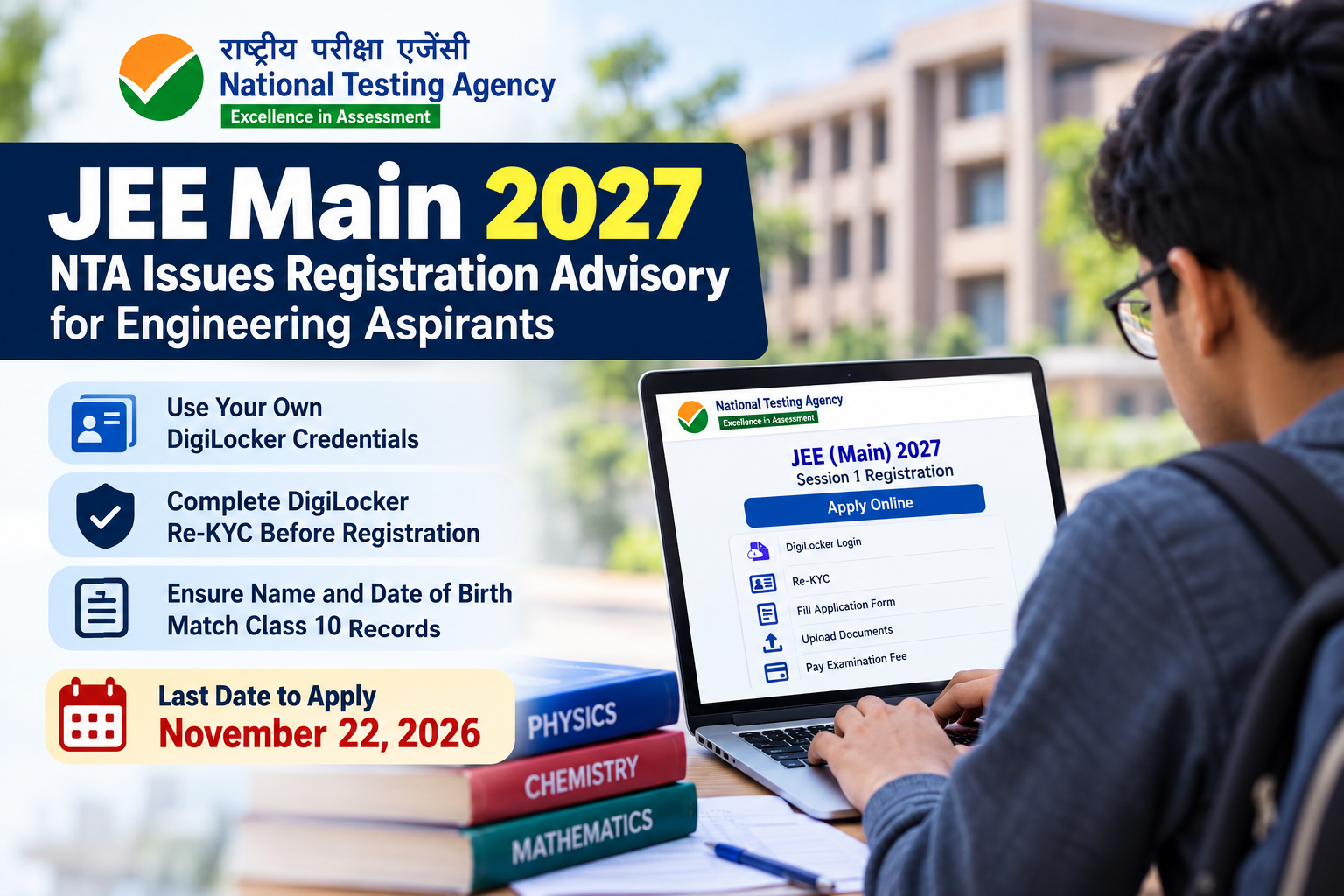
Official source for editorial verification: NTA JEE Main 2027 Registration and Advisory
The JEE Main 2027 registration process began on October 24, 2026. Eligible candidates seeking admission to undergraduate engineering, architecture and planning programmes can submit their applications through the official website, jeemain.nta.nic.in.
According to the latest advisory, candidates should use their own digital identity credentials, complete the required Re-KYC process through DigiLocker and ensure that their name and date of birth match the details recorded on their Class 10 certificate or marksheet.
The application deadline for JEE Main 2027 Session 1 is November 22, 2026. Candidates are advised to complete the registration process well before the deadline to avoid last-minute technical difficulties.
JEE Main 2027 Registration: Key Instructions Issued by NTA
The latest NTA advisory focuses on reducing errors during registration and helping candidates complete identity verification successfully.
Candidates should pay particular attention to the following instructions:
1. Use Your Own DigiLocker or Digital Identity Credentials
NTA has advised candidates to log in using their personal credentials for DigiLocker, JanParichay or e-Pramaan (MeriPehchaan).
Applicants should not use another person’s account to complete the registration process. Using their own credentials can help prevent discrepancies during identity verification and biometric authentication at subsequent stages of the examination process.
Candidates should ensure that the digital identity account they use belongs to them and that the details associated with it are accurate.
2. Complete DigiLocker Re-KYC Before Registration
Candidates have also been advised to complete Re-KYC through DigiLocker before filling out the JEE Main 2027 application form.
This step helps ensure that the latest available information is retrieved during the registration process.
Applicants should check their digital records and complete any required verification before proceeding with the application. This can help minimise discrepancies between the information submitted in the application and the details available through the identity verification system.
3. Ensure Your Name and Date of Birth Match Class 10 Records
One of the most important instructions in the advisory concerns the candidate’s name and date of birth.
NTA has clarified that these details entered in the JEE Main 2027 application form should match the information recorded on the candidate’s Class 10 certificate or marksheet.
Candidates should carefully verify the spelling of their names and their dates of birth before submitting the application.
Any mismatch could create difficulties during document verification or subsequent examination-related procedures. Applicants should check their original academic records rather than relying on memory when entering these details.
JEE Main 2027: Important Dates
Candidates applying for Session 1 should keep the following dates in mind.
| Event | Date |
|---|---|
| JEE Main 2027 Session 1 registration begins | October 24, 2026 |
| Last date to apply without a late fee | November 22, 2026 |
| Application window with late fee | November 23–26, 2026 |
| Application correction window | November 27–29, 2026 |
| Examination city information slip | December 30, 2026 |
| Admit card release | January 13, 2027 |
| JEE Main 2027 Session 1 examination | January 20, 21, 22, 23, 24 and 28, 2027 |
Candidates should check the official NTA website for any subsequent changes to the examination schedule.
How to Apply for JEE Main 2027 Session 1
Eligible candidates can complete the online application process by following these steps:
- Visit the official JEE Main website at jeemain.nta.nic.in.
- Open the online application link for JEE Main 2027 Session 1.
- Complete the registration process using the required personal and contact details.
- Use the appropriate personal digital identity credentials and complete the required verification.
- Fill in the application form with the necessary personal, academic and examination details.
- Upload the photograph, signature and other documents in the prescribed formats.
- Pay the applicable examination fee through the available online payment methods.
- Review all the information entered in the application form.
- Submit the application and download the confirmation page for future reference.
Candidates should read the official information bulletin carefully before submitting the form. They should also retain their application number, login details and payment confirmation for future use.
What Is JEE Main? Why Is the Examination Important?
JEE Main is a national-level entrance examination conducted by the National Testing Agency for admission to undergraduate engineering, architecture and planning programmes.
The examination is particularly important for students seeking admission to leading technical institutions across India.
JEE Main Paper 1 is used for admission to Bachelor of Engineering (BE) and Bachelor of Technology (BTech) programmes at institutions including the National Institutes of Technology (NITs), Indian Institutes of Information Technology (IIITs) and other participating institutions.
JEE Main also serves as the qualifying examination for JEE Advanced, which is used for admission to the Indian Institutes of Technology (IITs), subject to the applicable eligibility requirements.
Paper 2A is intended for Bachelor of Architecture (BArch) admissions, while Paper 2B is for Bachelor of Planning (BPlanning) programmes.
Candidates should review the official information bulletin for the detailed eligibility requirements applicable to their chosen programme.
JEE Main 2027: What Candidates Should Do Now
With the registration window open, engineering aspirants should complete the application process carefully instead of waiting until the last day.
Candidates should first verify their digital identity credentials and complete the required DigiLocker Re-KYC process. They should then cross-check their names and dates of birth against their Class 10 certificates or marksheets.
Applicants should also ensure that all required documents are available in the prescribed formats and that the examination fee has been paid successfully.
Students who encounter difficulties during registration should consult the official NTA website for the latest instructions and available assistance.
Conclusion
The latest JEE Main 2027 registration advisory serves as an important reminder for engineering aspirants to verify their digital identity details and academic records before submitting their applications.
Candidates planning to appear for Session 1 should complete the registration process before November 22, 2026, and regularly check the official NTA website for updates concerning the examination.
Careful attention to the registration instructions can help candidates avoid preventable errors and focus on preparing for the upcoming entrance examination.
Official website: https://jeemain.nta.nic.in/
Disclaimer: Candidates should refer to the official NTA notifications and information bulletin for the final and authoritative instructions regarding JEE Main 2027.

JEE Main 2027: NTA Issues Registration Advisory for Engineering Aspirants; Check Important Instructions added by admin on
View all posts by admin →