New Delhi, September 30, 2026: The National Council of Educational Research and Training (NCERT) has introduced several contemporary topics in its newly released Class 9 Social Science textbook, including income tax calculations, personal financial management, entrepreneurship, startups and governance.
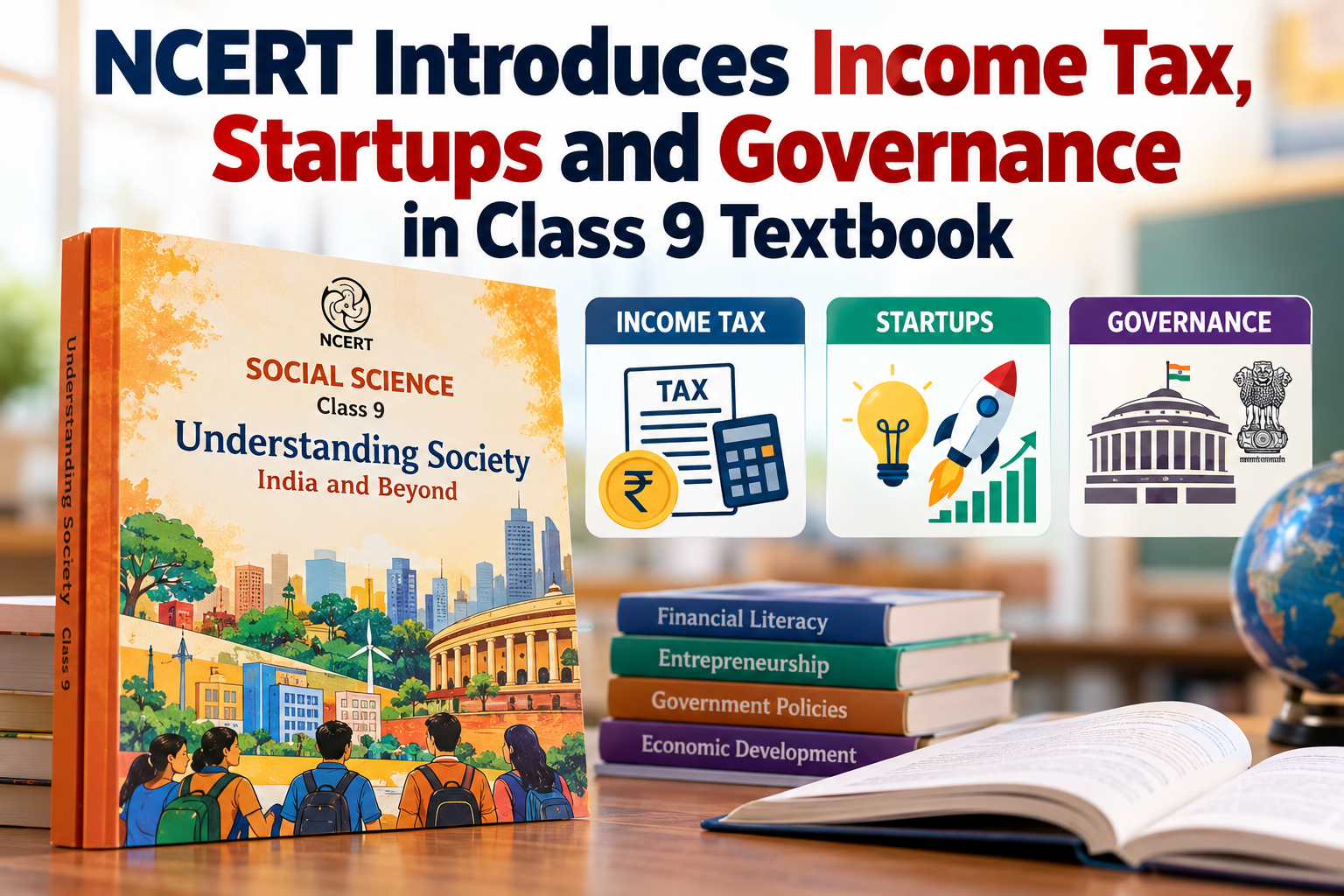
Titled Understanding Society: India and Beyond – Social Science Textbook for Grade 9, Part 2, the new textbook aims to connect classroom learning with practical aspects of India’s economic, social and political environment.
The textbook, released on September 29, 2026, is part of NCERT’s ongoing curriculum revision under the National Education Policy (NEP) 2020 and the National Curriculum Framework for School Education (NCF-SE) 2023.
The introduction of practical financial concepts and business-related topics is expected to give students a broader understanding of how individuals, businesses and government institutions contribute to the country’s development.
Income Tax and Financial Literacy Introduced in Class 9
One of the important additions to the revised Class 9 Social Science curriculum is the introduction of income tax calculations.
Under the chapter titled ‘Managing Your Personal Finances’, students are introduced to income tax calculations under India’s new tax regime.
The chapter explains how income tax slabs work through practical examples and calculations. It also highlights the importance of paying taxes honestly and on time as part of a citizen’s responsibility.
Students will learn how tax revenues contribute towards public services, infrastructure development and government welfare programmes.
The textbook also introduces the concept of financial protection through insurance, using the Ayushman Bharat Pradhan Mantri Jan Arogya Yojana (AB PM-JAY) as an example.
These additions are intended to familiarise students with financial concepts that they will encounter in their everyday lives.
From Small Businesses to Successful Startups
Another significant addition is the chapter titled ‘From Ideas to Startups’, which introduces students to entrepreneurship and India’s growing startup ecosystem.
Rather than limiting the discussion to theoretical business concepts, NCERT uses real-life Indian business stories to explain how small ideas can develop into successful enterprises.
One of the examples is Shri Mahila Griha Udyog Lijjat Papad, which began in Mumbai in 1959 when seven women pooled together just ₹80 to start a small business.
The cooperative subsequently expanded into a major enterprise, with more than 45,000 members and a reported annual turnover of ₹1,600 crore in 2023.
The textbook uses this example to demonstrate women’s entrepreneurship, collective ownership and the importance of cooperative business models.
Another case study highlights the journey of hotelier Mohan Singh Oberoi, who started his career as a hotel desk clerk earning ₹50 per month before establishing one of India’s major hotel businesses.
The chapter also discusses traditional business networks, including the Tamil Nadu Chettiar community, highlighting their contributions to trade, banking and financial activities.
Indian Startup Ecosystem and Viksit Bharat 2047
The revised textbook connects entrepreneurship with India’s long-term economic development goals, particularly the vision of Viksit Bharat 2047 and Atmanirbhar Bharat.
Students are introduced to India’s startup ecosystem, including businesses operating in sectors such as:
- Financial technology (FinTech)
- E-commerce
- Healthcare
- Agricultural technology (AgriTech)
- Digital services
- Innovation and technology
The textbook also refers to India’s growing unicorn ecosystem, highlighting the role of startups in employment generation, innovation and economic development.
It explains six important contributions of businesses to society:
- Creating employment and income opportunities.
- Producing goods and delivering services.
- Contributing to government revenue through taxes.
- Promoting innovation and technological development.
- Improving people’s quality of life.
- Supporting society through corporate social responsibility.
Through these examples, students are encouraged to understand entrepreneurship as an important driver of economic growth.
Governance and Public Policy: Understanding How India Functions
The new textbook also introduces students to India’s governance traditions and the functioning of public institutions through a chapter titled ‘Governance and Public Policy’.
The chapter connects historical traditions with modern governance institutions.
It discusses India’s national motto, ‘Satyamev Jayate’, derived from the Mundaka Upanishad, and the Supreme Court’s motto, ‘Yato Dharmastato Jayah’, from the Mahabharata.
The textbook also explains the historical significance of the Sengol, tracing its association with the Chola dynasty and its installation in the new Parliament building in 2023.
Students are introduced to seven important principles of good governance:
- Participation
- Rule of Law
- Accountability
- Effectiveness
- Inclusiveness
- Responsiveness
- Transparency
The chapter also uses the National Education Policy 2020 as an example of consultative and evidence-based policymaking.
Additionally, Khelo Bharat Niti 2025 is discussed to explain how government policies, sports organisations and citizens can contribute to nation-building.
Part of NCERT’s New Curriculum Framework
The introduction of these topics reflects NCERT’s efforts to make school education more relevant to contemporary economic and social realities.
The revised textbooks are being developed in line with the National Education Policy 2020 and the National Curriculum Framework for School Education 2023.
By introducing concepts such as taxation, insurance, entrepreneurship and governance at the secondary school level, NCERT aims to encourage students to develop practical knowledge alongside their regular academic learning.
The new textbook also places greater emphasis on understanding India’s economic development, traditional business practices and the role of citizens in building the nation.
What This Means for Class 9 Students
The inclusion of income tax, financial literacy and startup-related topics represents an important development in school education.
Students will get an opportunity to understand concepts that extend beyond conventional textbook learning. The practical examples of Indian businesses and government policies can also help them develop an early understanding of financial responsibility, business management and civic participation.
Teachers and schools following the revised NCERT curriculum will need to familiarise themselves with the new chapters and incorporate these concepts into classroom discussions.
The new Class 9 Social Science textbook, Understanding Society: India and Beyond – Part 2, is available through NCERT’s authorised publication channels.
Official Website: https://ncert.nic.in/
Source: NCERT and media reports dated September 29–30, 2026.

NCERT Introduces Income Tax, Startups and Governance in Class 9 Textbook added by admin on
View all posts by admin →