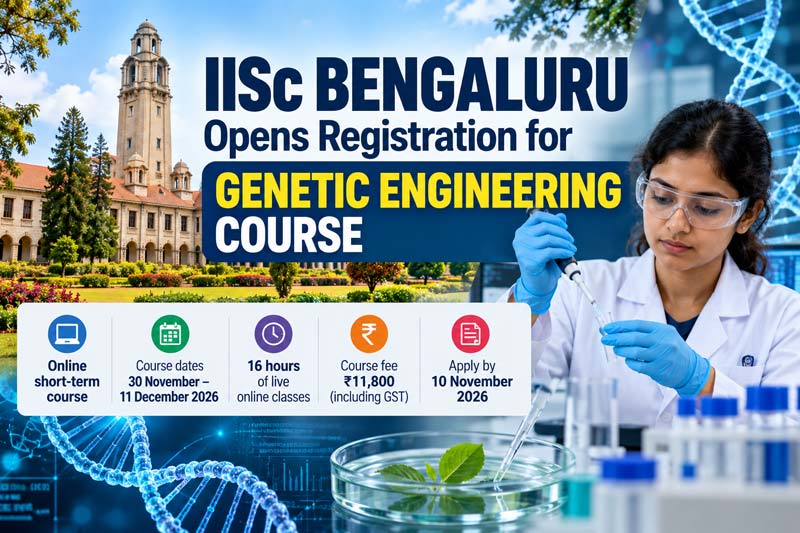
Bengaluru, October 13, 2026: The Indian Institute of Science (IISc), Bengaluru, has invited applications for its online short-term course, Advances in Genetic Engineering, offering students, researchers and working professionals an opportunity to explore emerging developments in biotechnology and molecular biology.
The programme, offered through the institute’s Centre for Continuing Education (CCE), will be conducted from November 30 to December 11, 2026. Interested candidates can submit their applications online until November 10, 2026.
The 16-hour course will cover advanced concepts in genetic engineering, including genome editing, molecular diagnostics, gene therapy and genetic technologies used in medical research.
IISc Genetic Engineering Course 2026: Key Highlights
| Particulars | Details |
|---|---|
| Institute | Indian Institute of Science (IISc), Bengaluru |
| Course Name | Advances in Genetic Engineering |
| Conducting Department | Centre for Continuing Education (CCE) |
| Course Mode | Online – Live Classes |
| Course Dates | November 30 – December 11, 2026 |
| Total Duration | 16 Hours |
| Application Deadline | November 10, 2026 |
| Course Fee | ₹11,800 (Including 18% GST) |
| Course Instructor | Dr. N. Ravi Sundaresan |
| Official Website | cce.iisc.ac.in |
What Will Students Learn?
The programme aims to provide participants with an understanding of modern genetic engineering techniques and their applications in biotechnology, healthcare and scientific research.
The curriculum will cover several important areas, including:
- Molecular Diagnostics: Understanding molecular techniques used in disease detection and diagnosis.
- Gene Regulation: Exploring how gene expression is controlled and its significance in biological processes.
- Genome Editing: Introduction to modern genetic modification techniques and their research applications.
- Gene Therapy: Understanding approaches used to treat genetic disorders through genetic interventions.
- Transgenic Models: Learning how genetically modified organisms are used to investigate human diseases.
- Emerging Biotechnology Applications: Exploring recent advances in genetic engineering and their potential applications in medicine and research.
The course is designed to help participants strengthen their understanding of genetic engineering and its expanding role in modern biological sciences.
IISc Genetic Engineering Course 2026: Eligibility Criteria
According to the published course information, candidates who have completed a bachelor’s degree in science are eligible to apply.
Students currently pursuing undergraduate science degrees may also apply, provided they possess a basic understanding of biology.
The programme is particularly relevant for:
- Undergraduate and postgraduate students pursuing biotechnology, life sciences and related subjects.
- PhD scholars and postdoctoral researchers.
- Faculty members and academic researchers.
- Professionals working in biotechnology and biopharmaceutical companies.
- Researchers involved in vaccine development and gene therapy.
- Professionals working in agricultural biotechnology.
- Clinical researchers, pathologists and bioengineers.
Applicants should review the official eligibility requirements before submitting their applications.
Course to Be Conducted Through Live Online Classes
The IISc genetic engineering programme will be delivered through live online sessions, allowing participants from different parts of India to attend without travelling to Bengaluru.
The course comprises 16 hours of instruction, scheduled between November 30 and December 11, 2026.
The online format may be particularly beneficial for working professionals and students who wish to develop additional technical knowledge alongside their existing academic or professional commitments.
Course Faculty: Dr. N. Ravi Sundaresan
The programme will be conducted by Dr. N. Ravi Sundaresan, Associate Professor in the Department of Microbiology and Cell Biology at IISc Bengaluru.
His research focuses on understanding the molecular mechanisms associated with heart failure, cardiac hypertrophy and metabolic diseases.
His work involves molecular biology and genetic engineering techniques, including the use of transgenic models to investigate disease mechanisms.
Participants will have the opportunity to learn about developments in genetic engineering from a faculty member actively involved in biological research.
IISc Genetic Engineering Course Fee 2026
The total fee for the programme is ₹11,800, including 18% Goods and Services Tax (GST).
Candidates should carefully review the payment instructions and applicable terms on the official registration portal before completing their applications.
How to Apply for IISc Genetic Engineering Course 2026?
Interested candidates can register online through the IISc Centre for Continuing Education website.
Steps to apply:
- Visit the official IISc CCE website at https://cce.iisc.ac.in/.
- Navigate to the Short-Term Courses section.
- Find the programme titled “Advances in Genetic Engineering.”
- Open the course details and review the eligibility requirements.
- Follow the registration instructions provided on the website.
- Complete the application form with the required information.
- Pay the applicable course fee according to the instructions.
- Save the registration confirmation for future reference.
Last Date to Apply: November 10, 2026
Candidates are advised to complete the registration process before the deadline.
Why Is Genetic Engineering an Important Field?
Genetic engineering has emerged as an important area of scientific research, with applications across healthcare, agriculture, pharmaceuticals and biotechnology.
Technological developments in genome editing and molecular biology have expanded opportunities to investigate genetic disorders, understand disease mechanisms and develop new therapeutic approaches.
Genome-editing technologies such as CRISPR-Cas9 have also contributed to advances in biological research by enabling scientists to make targeted modifications to genetic material.
Knowledge of genetic engineering can be valuable for students pursuing careers in biotechnology, molecular biology, biomedical research and related scientific fields.
Short-term academic programmes can help students and professionals develop familiarity with emerging technologies and research applications.
Frequently Asked Questions (FAQs)
1. What is the last date to apply for the IISc Genetic Engineering Course 2026?
The last date to submit applications is November 10, 2026.
2. When will the IISc Genetic Engineering Course begin?
The course is scheduled to begin on November 30, 2026, and conclude on December 11, 2026.
3. What is the fee for the IISc Genetic Engineering Course?
The total programme fee is ₹11,800, including 18% GST.
4. Is the IISc Genetic Engineering Course online or offline?
The programme will be conducted online through live classes.
5. Can undergraduate students apply?
Yes. Students pursuing undergraduate science degrees may apply, provided they have the required basic understanding of biology.
6. What is the duration of the course?
The programme comprises 16 hours of online instruction.
7. Who will conduct the course?
The programme will be led by Dr. N. Ravi Sundaresan, Associate Professor in the Department of Microbiology and Cell Biology at IISc Bengaluru.
8. Where can candidates register?
Candidates can register through the official IISc Centre for Continuing Education website.
Conclusion
The IISc Bengaluru Advances in Genetic Engineering Course 2026 offers an opportunity for students, researchers and professionals to explore modern developments in molecular biology and genetic technologies.
With its online delivery format and focus on emerging biotechnology applications, the programme may be useful for individuals interested in strengthening their knowledge of genetic engineering.
Eligible candidates should submit their applications before November 10, 2026, and consult the official IISc website for complete registration instructions.
Official Website: https://cce.iisc.ac.in/
Source: Indian Institute of Science, Bengaluru – Centre for Continuing Education.

IISc Bengaluru Opens Registration for Genetic Engineering Course 2026; Apply by November 10 added by admin on
View all posts by admin →